The math nobody runs: how much revenue is your shop losing every week to calls that never got picked up?
It's a worse number than you think. And it's fixable — not by working longer hours, but by answering the phone smarter.
A missed call isn't just a lost call. It's a lost job — almost every time.
The reason is simple: most homeowners calling about a garage door problem aren't researching options. They have a broken door, a stuck car, or a spring that snapped, and they're hitting Google for the closest shop that picks up. Studies put the average number of shops a homeowner calls before booking at two or three. If you're not first, you're often nothing.
Run the math on your own shop. The average garage door job runs somewhere between $200 (basic spring repair) and $1,500 (new door install), with most service calls landing in the $250-$500 range. If you're missing five calls a week and even half convert when you do answer, that's $625-$1,250 a week walking to your competitors. Annualized, that's a meaningful chunk of your revenue.
The truth most shop owners don't want to look at: the missed-call problem is bigger than the marketing problem. You don't need more leads. You need to answer the ones you already have.
Most shops assume missed calls happen because they're busy on the job. That's part of it, but it's not the whole story. The breakdown usually looks like this:
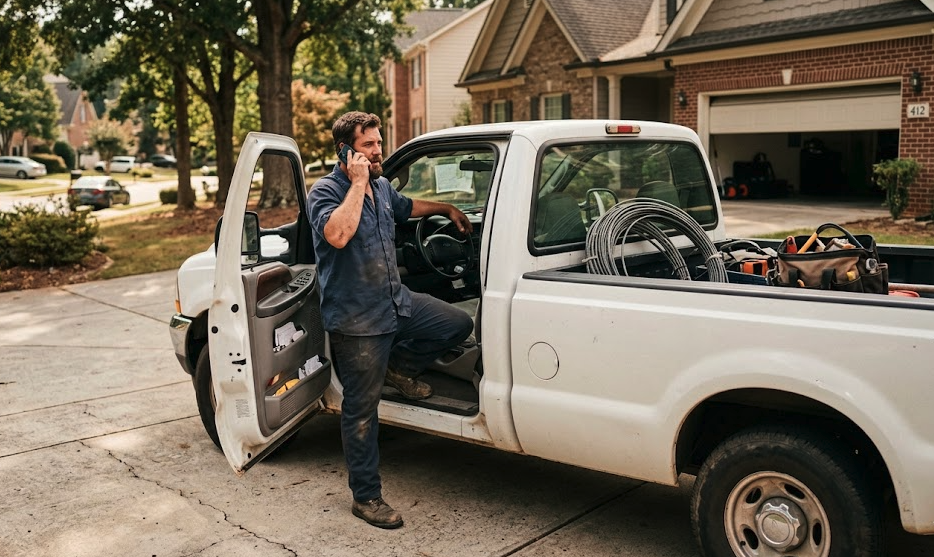
On a job (one or both hands occupied). The biggest source. You're under a sectional adjusting a cable, you're up a ladder with a winding bar, you're guiding a new door panel into the track — the phone rings, you can't answer.
Driving between jobs. The second-biggest. Many states make this either illegal or unsafe to answer.
After hours, evenings, weekends. A huge chunk of garage door calls hit outside business hours. If you're not answering, you're not catching them.
Phone tag. You call back. They've already booked someone else. You both lose.
Voicemail. The default fallback. Most homeowners don't leave one. They just hang up and try the next shop.
1. Stop sending calls to voicemail. Voicemail is the place jobs go to die in garage door work. If a customer hits voicemail, assume the job is gone. Even shops with great voicemail messages lose the majority of those calls. The fix is structural: route calls to something that actually answers.
2. Set up real after-hours coverage. Most shop owners forward to their cell after hours and call it done. That works until you're asleep, at dinner, or driving. The shops winning the after-hours game route to an answering service — live or AI — that picks up as the business.
3. Capture intake details on every call. A missed call is bad. A picked-up call where you didn't capture the address, opener brand, or symptoms is almost as bad — it means a callback, a possible no-show, and a tech rolling without the right parts. Whatever system you use should be capturing structured intake every time.
4. Make booking the default outcome. The end of a call should be a booked appointment, not "we'll get back to you." Every "we'll call you back" is a coin flip. Most of those don't convert.
For years, the only real option for a small garage door shop was a live answering service. They worked, but they were expensive ($200-$700+/month) and they didn't really know your trade. So most shops just lived with the missed calls.
AI answering services changed the math. A service like Vallo picks up every call 24/7, knows your trade, books on your calendar, and captures structured intake — all at a flat rate starting at $20/month. The economics finally work for a one-truck operation, not just a 20-employee outfit.
The shops capturing the most calls aren't working longer hours. They're answering the phone smarter.
If you only do one thing to improve your garage door business in the next month, fix your missed-call problem. More marketing, more trucks, more techs — none of that matters if the calls you're already generating are hitting voicemail.
You can call Vallo's demo line to hear what answering every call looks like.