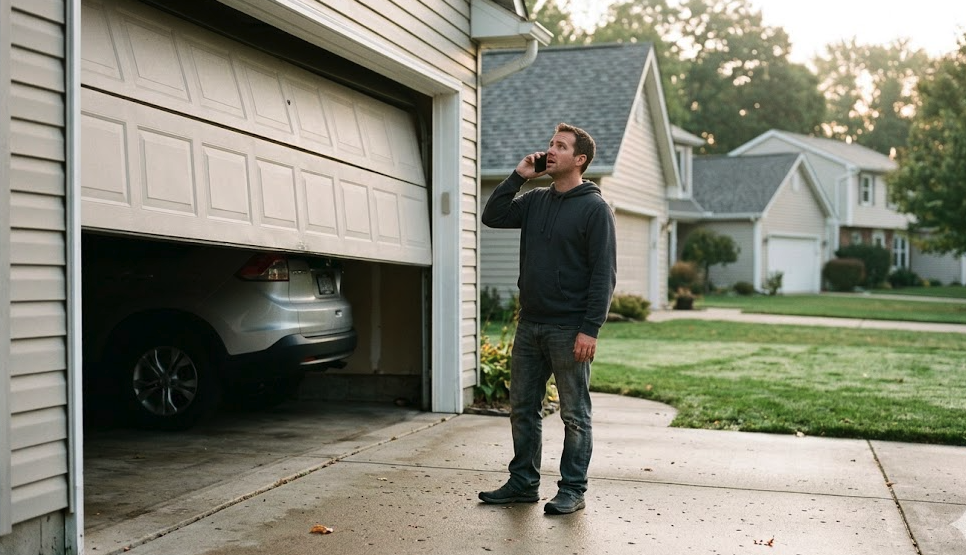
You don't need someone to take a message. You need someone to book the spring repair before the customer calls the next number.
That's the difference between a traditional answering service and what good answering looks like in 2026. And it's why a lot of garage door shops are quietly switching.
Here's an honest breakdown of what to look for, what to avoid, and how to think about pricing — whether you end up choosing AI, human, or some mix of both.
The job isn't "answer the phone." It's get the call to a booked appointment with the right details on the ticket.
Diagnose the problem at intake. A spring failure, an opener issue, and a bent panel are three different trucks, three different parts, and three different price ranges. A good service asks the right questions: Did you hear a loud bang? Is the door fully closed or partway? Does the remote light up? Those answers should land on your tech's phone before they leave the shop.
Qualify the urgency. "Door won't close all the way" and "car is trapped inside the garage" are not the same call. Your service needs to know which is which — and route them differently.
Book the appointment. Not "we'll have someone call you back." Actually put it on the calendar. Confirm the address. Confirm the contact number. Send the customer a confirmation.
Capture the details that prevent a second trip. Opener brand. Door height. Single or double car. Spring color (if they can see it). These are five-second questions that save you a 45-minute round trip later.
What they're good at. A live human can handle a panicked caller with empathy. They can read a script. They can take a message that's better than a voicemail.
Where they fall short for garage door work. Most traditional services don't know garage doors. They don't know the difference between a torsion spring and an extension spring. They can't qualify "noisy opener vs. broken opener." So the call ends with "we'll have someone call you back" — and now you're racing the next shop to the callback.
The cost reality. Per-minute pricing means a single long emergency call can run $15-20. Multiply that across a few hundred calls a month and the math gets uncomfortable fast.
What they're good at. Modern AI services (like Vallo) actually book the appointment. They handle FAQ-style questions about spring repair pricing, brand support, and service areas without escalation. They run 24/7 without surge pricing. And they don't get tired at 9 p.m. when the calls are still coming in after the late-shift homeowner gets home from work.
Where they fall short. A purely AI system shouldn't try to handle a wildly emotional caller, a multi-property commercial account negotiation, or a quote that needs a site visit. The honest framing is: AI handles the 80% well and transfers the 20% that needs you.
What to look for. Make sure it transfers — not just "takes a message" — when it's out of its depth. Make sure it integrates with your scheduling tool. Make sure you can train it on your specific service area and pricing.
How does it handle a stuck-door emergency at 6 a.m.? If the answer is "we'll text the on-call tech," ask exactly how. Text? App push? What if the tech doesn't reply?
Can it actually book on my calendar? Not just collect a callback number. Watch a demo of a real booking flow.
What does it ask the caller about the door itself? If the intake questions are generic, the tech is rolling blind.
What's the pricing structure? Per-minute pricing penalizes you for busy days. Flat-rate is usually cleaner for garage door work, where call volume swings wildly with weather.
Can I listen to actual calls? Recordings and transcripts should be standard, not premium.
"We'll have someone call you back." If this is the standard close, the service is just a fancier voicemail. Move on.
No transcripts. You should be able to read what was said on every call. Period.
Long contracts. Anyone confident in their product should be willing to do month-to-month. Multi-year lock-ins are a sign the product can't stand on its own.
"AI-powered" with no demo. If they won't let you call the system live before you sign up, that's a flag.
The right answering service for a garage door shop isn't the cheapest one — it's the one that actually books the job while you're on the ladder. Get a demo. Listen to real calls. Look at the transcripts. If the system can't qualify "broken spring vs. bad opener vs. damaged panel" in a 90-second call, keep looking.
If you want to see how Vallo handles real garage door calls, you can call our demo line and try it yourself. No signup required.