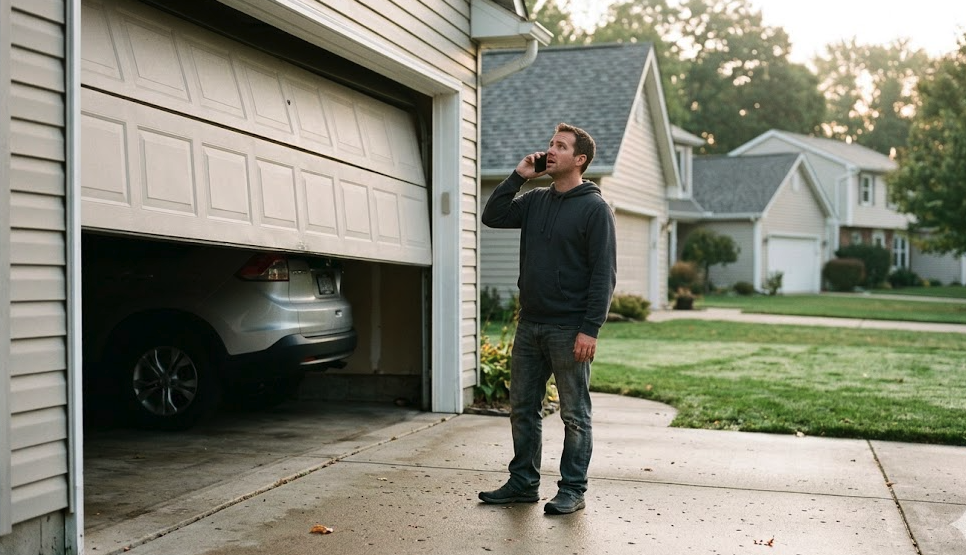
It's 7:12 a.m. on a Tuesday. A homeowner pulls into their garage the night before, comes out in the morning, hits the wall button, and hears a loud bang. The door doesn't open. The car is stuck inside.
They call you. You're three jobs deep already.
Here's exactly what happens with a good AI answering service on the other end of that call.
Ring 1-2: The greeting. Vallo picks up as your business, by your business name. Not "Hello, you've reached an answering service" — "Hi, this is [Your Shop Name], how can I help you?" The caller doesn't realize they're not talking to your office.
The first 15 seconds: The story. The customer explains what happened. "I went to open my garage door this morning and it made a loud bang and won't open." Vallo listens — really listens, not just records — and pulls the key facts: loud bang, door won't open, this morning.
The diagnostic questions. A good AI service doesn't just collect a name and number. It asks: "Is the car stuck inside?" "Is the door fully closed or hanging partway?" "Do you have a single-car or double-car door?" "Do you know the brand of the opener?" Each answer goes on the ticket.
The urgency call. Based on your rules, Vallo knows that "car trapped inside" is a same-day priority. It checks your live calendar and offers the earliest realistic slot: "I can get a tech out between 11 and 1 today — does that work?"
The booking. Vallo confirms the address, the contact number, the access details. It books the appointment directly on your calendar. The customer gets a text confirmation with the time window.
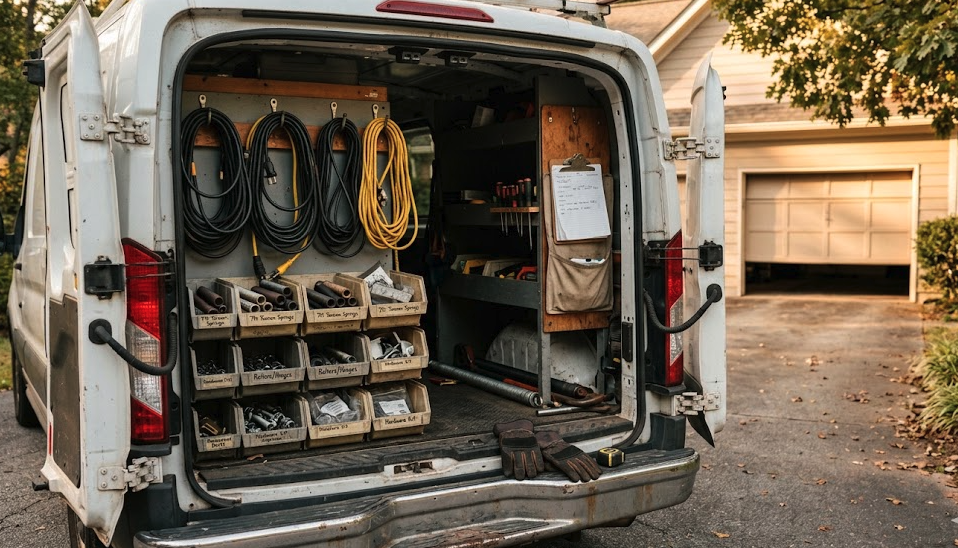
The handoff. Your tech's phone gets a summary: name, address, "loud bang this morning, door won't open, car stuck inside, double-car door, LiftMaster opener." They roll with the right springs already on the truck.
From your side, the entire interaction is a calendar event and a Slack notification (or email, or text — your pick).
You didn't pick up the phone. You didn't pull off the ladder. You didn't have a half-distracted conversation with a customer while your hands are full. And the spring job is booked before the customer would've otherwise called the next shop.
The caller is in panic mode. A good AI service stays calm and steady, validates the situation ("I understand that's stressful — let me see what we can get out there"), and moves through intake without rushing the caller off the phone.
The caller asks a price question. Most spring jobs follow a predictable price range. Vallo can quote a starting range ("Spring replacement typically starts around $X — your tech will give you a firm price on site") so the customer isn't going in blind.
The caller wants to talk to you specifically. Vallo transfers. It doesn't try to be a wall between you and your customers — it's a backstop for the calls you can't take.
The caller has a problem outside the script. A commercial account with a complex contract, a weird custom door, a warranty dispute — Vallo recognizes when it's out of its depth and routes the call to you directly. Vallo doesn't guess — it transfers.
A broken spring call should end with a booked appointment, the right details on the ticket, and you not having to stop what you're doing. That's the whole job.
If your current setup ends those calls with "we'll have someone call you back" — or worse, voicemail — you're handing jobs to your competitors every week. A good AI answering service closes that loop.
Want to see it in action? You can call our demo line and walk through a broken-spring call yourself. No signup needed.